


The Mysterious Cult of Mithras

In the early Roman Empire, there existed a belief system so mysterious that there is almost no recorded evidence of its practices, and all information resides in the cave like temples, called a Mithraeum, that have been found spread across the Empire from Hadrian's Wall to the banks of the Euphrates, in Dura Europos, Syria.

Mithras: The god behind the mystery
The origins of Mithras have been intensely debated. The Persians had a deity called Mithra, and whilst the Roman god is different, it was likely inspired and an adaptation for the Roman people. The main image we see of Mithras is him wearing a Phrygian cap and killing a sacred bull. This depicts renewal and the victory of light, and the cult valued bravery, loyalty and fraternity, and due to this the cult was popular amongst the Roman army, with many mithraea being found in Roman bases. Mithras was often linked to the sun god Sol Invictus, and there have been images of Mithras in Roman temples, of Mithras banqueting with Sol. The belief and following of Mithras are viewed as a rival of early Christianity, so much so that they faced persecution from Christians, which eventually led to the death of the religion.
So, what do we know about the cult?
Honestly not a lot.
We have numerous archeological finds, including monuments, artefacts and temple remains, which have contributed to modern knowledge about Mithraism throughout the Roman Empire. Through these find we know that the cult was active in Rome by the late 1st century CE, and it is suggested that it died out during the 4th century CE, and by the turn of the 4th century, the cult had stretched from the Syrian desert to Hadrian's Wall. This is supported by the fact that there is virtually no evidence of the cult continuation into the 5th Century. We also have limited epigraphical evidence, which what we do have is even more difficult to date, that comes from roughly 150-250 CE, these are largely member inscriptions, with our last known dated inscription being a dedication by the pater, the leader of the community, in the year 325 CE, that was found on a foundation of a Mithraeum in Upper Germany. Outside of dedicatory inscriptions there are almost no Mithraic literary sources, with all surviving written accounts describing to the cult emanated from outsiders.

Whilst the cult was a Roman one, the earliest dated evidence that we have does not stem from Italy, but rather from the provinces.
The first archaeological and epigraphical record we have of the cult is from the Rhine frontier at Nida, modern day Frankfurt-Heddernheim, Germany. A dedication found in Nida, dates to as early as 90 CE, with a second being built around 100 CE, which suggests that the cult had become popular in the area. Since this discovery there have been a large number of Mithraea found in Eastern Gaul, Rome, Ostia and several well-preserved Mithraea have even been found around the fertile crescent, a crescent shaped region in the Middle East, such as at Dura Europos in Syria. It also has notable popularity on Hadrian's Wall during the Severan period, owing much of this success to a strong following from customs officials and soldiers.

Temples of Mithras are usually sunk below ground, cave like in appearance and are very distinctive. In their basic form, Mithraea are entirely different from the temples and shrines of other cults from around the same period. All Mithraea were designed to recreate a space, rather than actually be that space, since Mithras slaying the bull was the central image of the cult and was often depicted as taking place in a cave, each temple was design as such. No Mithraea was any more special or authentic than any other, as they all held the exact same layout. Regarding recruitment into the cult, up until the 3rd century it was male only. And in order to join, perspective members would have to go through an intensive initiation ritual, which, once again due to our lack on literary evidence, we know very little about. We also know that there were seven grades of initiation into Mithraism, each of which has a symbolic emblem that represents each grade, and that are connected to the grade or are symbols of the planets. These grades are:
Corax: The raven or crow, symbol is a raven, beaker or caduceus, connected to Mercury
Nymphus: The bridegroom, symbol is a lamb, hand bell, veil or circlet, connected to Venus
Miles: The soldier, symbol is a pouch, helmet, lance or breastplate, connected to Mars
Leo: The Lion, symbol is a betillum, sistrum, laurel wreath or thunderbolt, connected to Jupiter
Perses: The Persian, symbol is a hooked sword, Phrygian cap, sickle of lunar crescent, connected to Luna
Heliodromus: The sun-runner, symbol is a torch, whip, robes or images of Helios, connected to Sol
Pater: The father, symbol is a patera, mitre, shepherd's staff or cape, connected to Saturn
One other major part of ancient religion, that we know little about within the cult of Mithras, is the importance of sacrifices. We have evidence for such activities existing in some of the Mithraeums found, but overall, that evidence is patchy.
Why did the cult eventually disappear?
This is one secret we may never know.
Firstly, it is difficult to know when the cult of Mithras came to an end, as our only real evidence of their practices coming to an end is the cases in which the mithraea were destroyed or fell into ruin. Also taking into consideration that, as mentioned above, that we had virtually no evidence of the cult into the 5th century CE. Since dating the cult is general is difficult, it is no surprise that it is hard for us to definitively know when the cults following came to a close.
Another factor is that it never became a cult supported by the state with public funds and would have gone unrecognized as it was never admitted to the official list of festivals celebrated. This would have put it into competition with other religions and cults that were being recognized on a larger scale, such as Christianity, which would have likely slowed down its growth. As well as the fact that it would have likely faced prosecution during the rise of Christianity.
Two Mithraeums I want to highlight
In both my studies, and in my everyday life, I have come across two Mithraeums that I want to highlight here.
The first being the Mithraeum found at Dura Europos.

Dura Europos is a Syrian fort, that sits along the Euphrates, and for part of its life it was under Roman control. Specifically, as a Roman army camp, which was established ca 211 CE. We know that the Romans were here as they established specific buildings wherever they went, and in particular Mithraeum's. This Mithraeum in particular went through three phases.
The Early Mithraeum, ca 165-210 CE, had inscriptions and had a Palmyrene influence.
The Middle Mithraeum, 210-240 CE was demolished and enlarged, likely to adjust to the growth of the Roman population.
The Late Mithraeum, 240-256.
This final stage is what would have been found once Dura was rediscovered in 1920, after it had sat abandoned and buried.
The second is the Mithraeum in the heart of London
The London Mithraeum, sits in the heart of London, located beneath Bloomberg's European headquarters, is a glimpse into the past located amongst the modern high rises of the city.

In September of 1954, during planned archaeological excavations, the marble head of a statue of Mithras was found. This discovery led archaeologist to confirm that a nearby structure was in fact a mithraeum.
The site of the mithraeum lies over the course of one of London's lost rivers, and is thought to have been built in the 3rd century after Londinium was founded by the Romans.
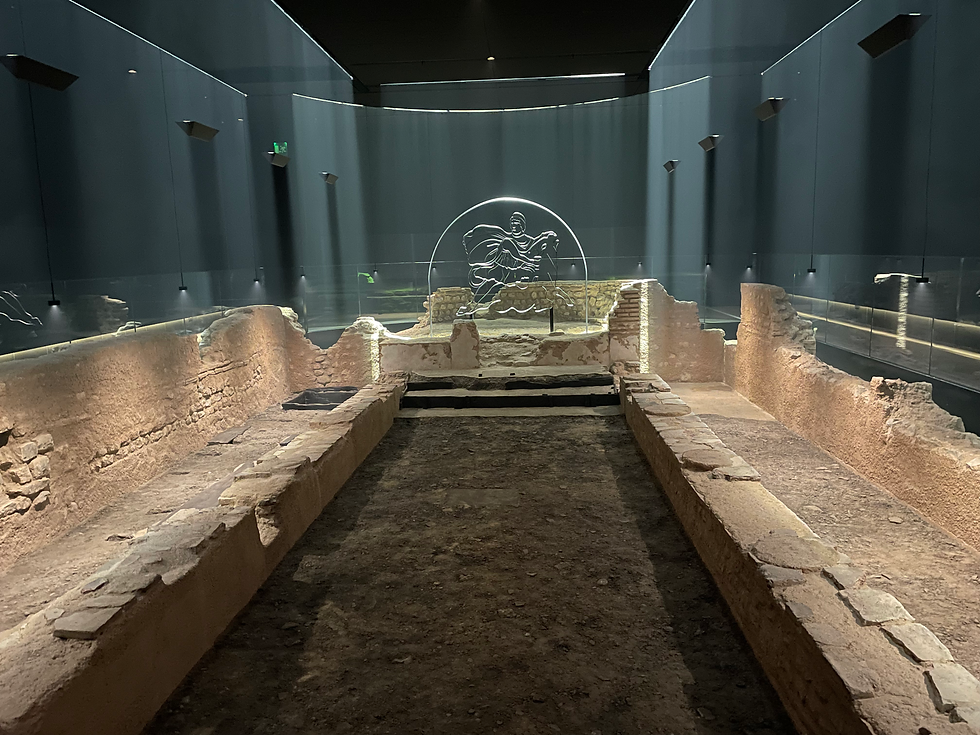
Having had the chance to visit the site when I was last in London, it was amazing to see something like this in person. I feel that we often forget how much history the ground we walk on holds, and the wonders like this could literally be buried right under our noses.
Sources
The London Mithraeum
Clauss, M. (2001). The Roman Cult of Mithras: The God and His Mysteries (First edition.). Routledge
Walsh, D. (2018). The cult of Mithras in late antiquity : development, decline, and demise circa A.D. 270-430. Brill.

Comments